Little Suitcase of Unprocessed Feelings
There are certain workplace moments that do not feel dramatic enough to explain, but still tell you everything.
No one screams. No one flips a table. No one storms out with a blazer over one shoulder like the season finale of a legal drama. Unfortunately, it is smaller than that. A tone shift. A vague answer. A process that suddenly appears after the real conversations have already happened.
That was the shape of this one.
A role opened. I was encouraged to apply. The first conversation felt promising. There was interest, energy, momentum. Then conversations happened behind the scenes, and suddenly the story changed. What had felt like alignment became “process.” What had felt like opportunity became “we need to make the best decision for all teams.”
Which is one of those sentences that sounds mature until you realize it is wearing too much foundation.
To be clear, process is not the villain. Fairness matters. Opening roles to multiple candidates can be the right thing to do. But process only feels clean when it starts clean. When it appears halfway through the story, after enthusiasm has already been extended and leadership has weighed what losing you might cost, it starts to feel less like fairness and more like staging.
Very polished. Very reasonable. Very “we value transparency” in a font that has never told the truth.
The phrase that stayed with me was not even about the role. It was how the situation was described. At one point, a senior leader referred to it as moving chess pieces, getting the pieces in order, making sure the board worked.
I understand what was meant. Teams have needs. Leaders balance talent, timing, coverage, and risk. I am not naive to that. I have moved work around. I have asked people to stay steady when they wanted motion.
But there is a difference between managing an organization and talking about people like objects inside it.
I am not a chess piece. I have a career. I have judgment. I have options. I have a life outside the board. And unlike a chess piece, I can get up and leave the table.
That was the first lesson.
The second lesson came when I named how it felt.
The response was less about repair and more about containment. I was told there had been a misunderstanding. I was told not to speak publicly in ways that could be critical.
And that is where the whole thing shifted for me.
Because when someone says, “I do not trust how this went,” and the answer is basically, “Please make sure that feeling does not become visible,” the priority is not trust. It is optics.
That does not make everyone involved a villain. Real life is annoying like that. People disappoint you and still try to help you. They use the wrong metaphor and later do the right thing. They hurt you and then show integrity. Nobody stays neatly in the villain costume, which is deeply inconvenient because clean villainy would be much easier to merchandise.
But the moment still taught me something.
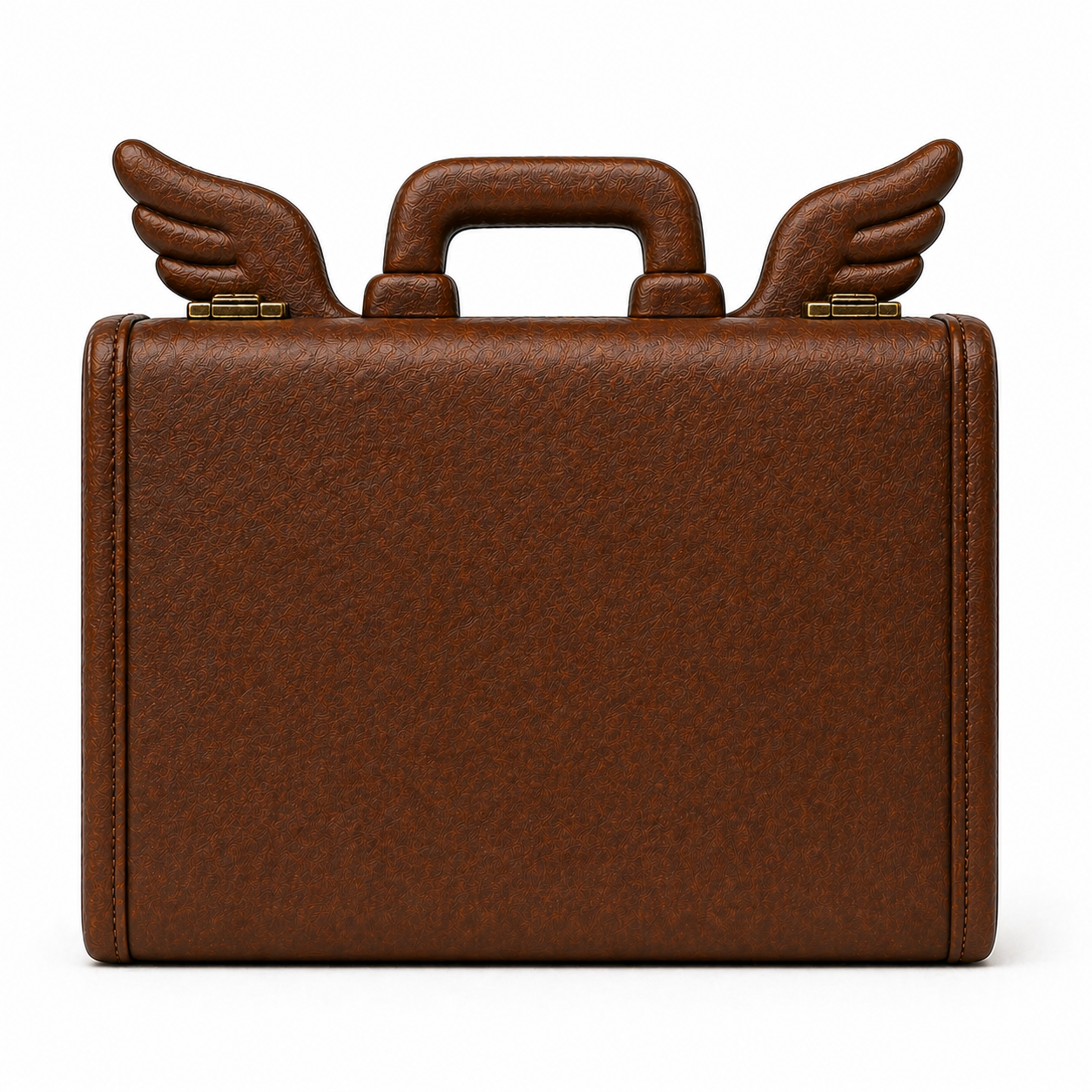
We are all walking around with our own little suitcase of unprocessed nonsense.
That is the phrase that clicked for me.
Because it is true. Everyone has one. A little bag full of old fears, control issues, half-healed stories, ego bruises, approval hunger, childhood weirdness, and the emotional equivalent of three tangled phone chargers.
Some people carry theirs quietly. Some people bring theirs into meetings and swing it around like a tiny leather wrecking ball.
I have one too.
Mine has the old sensitivity to being underestimated. The reflex to notice when decisions are being made around me instead of with me. The part of me that gets very calm when I am angry, which is convenient professionally and alarming spiritually. The part that can smell a managed narrative from across the room and immediately wants to subpoena the vibes.
So this is not a story about how everyone else had baggage and I arrived weightless, moisturized, and emotionally complete. Please. I am self-aware, not fictional.
The real lesson is more useful than that.
Choosing yourself is not always about proving you were right. Sometimes it is about deciding what you are no longer willing to carry.
I can carry what is mine. I can examine it. I can own it. I can ask where my reaction is coming from and what old story it may have touched.
But I will not carry someone else’s discomfort with honesty. I will not carry a leader’s fear of visibility. I will not carry an organization’s need for silence and mistake it for professionalism.
Not everything handed to you is yours to hold.
That sentence became the center of the whole thing.
Some people hand you confusion and call it context. Some hand you avoidance and call it process. Some hand you optics and call it leadership. Some hand you their little suitcase of unprocessed nonsense and expect you to walk around like a polite emotional bellhop in business casual.
No.
I have luggage of my own. Mine at least has personality.
That is where the object started to make sense to me. The little suitcase full of unprocessed nonsense became more than a line. It became the whole thesis in miniature.
We all carry something. Some bags are heavier than others. Some are inherited. Some are packed for us. Some we keep reopening even though we know exactly what is inside. And maybe part of healing is not pretending the bag is gone. Maybe it is making it visible. Making it smaller. Making it funny. Making it something you can clip to your keys instead of dragging behind you like a dead body in a luxury tote.
So I want to turn it into a keychain.
A tiny suitcase. A tiny burden. A little joke you can carry on purpose.
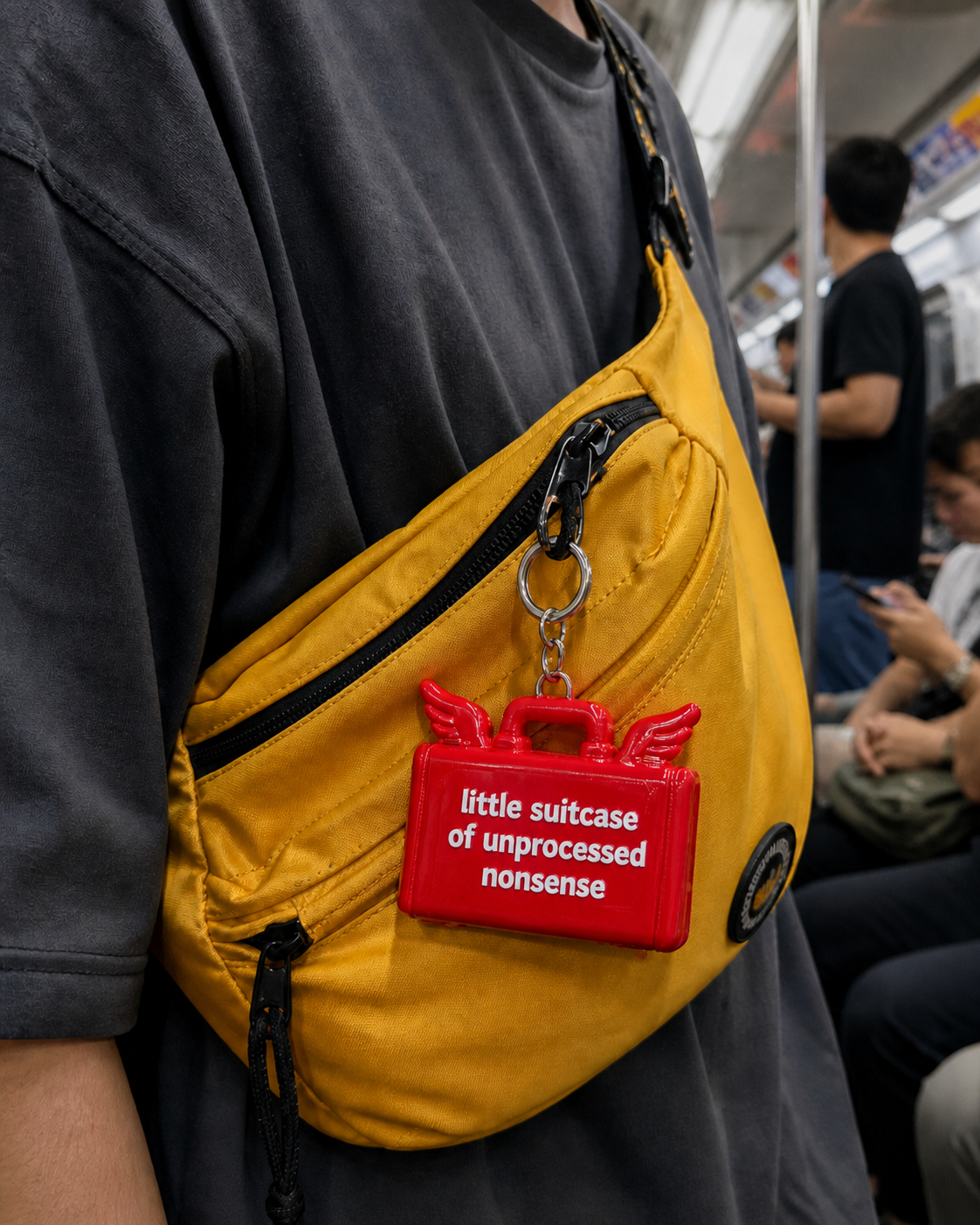
Because there is something tender in that. The idea that we all have our own nonsense, and instead of hiding it, we can wink at it. We can admit it. We can carry it together without making each other responsible for unpacking the whole thing.
People do not have to carry my baggage. I do not have to carry theirs. Care does not require becoming someone’s emotional luggage cart. Leadership does not require silence. Loyalty does not require self-abandonment. And choosing yourself does not always mean leaving the room dramatically while a wind machine appears from nowhere, though emotionally I support the production value.
Sometimes choosing yourself is quieter.
It is staying excellent while becoming less available for manipulation. It is telling the truth without needing the room to clap. It is realizing that endurance is not the same as alignment. It is dropping what was never yours, then looking at what remains and asking, “Okay, what can I make from this?”
That is the part I keep coming back to.
This whole experience reminded me why I have grown tired of corporate theater, especially in industries that love to talk about transformation while still operating through fear, optics, and control.
Everyone wants to discuss the future of work until someone tells the truth about the present of work. Then suddenly innovation needs a fainting couch.
I do not want to spend my life translating my humanity into language institutions find comfortable.
I can work hard. I can lead. I can collaborate. I can be strategic, thoughtful, fair, and sharp. I can hold complexity. I can even admit that the people who hurt us are often carrying their own tiny suitcases too.
But I cannot keep confusing performance with trust.
And I cannot keep carrying baggage that was handed to me by people who never planned to help unpack it.
So no, I am not a chess piece.
I am also not the board.
I am the person who noticed the metaphor, put down the suitcase that was not mine, and turned the rest into something I could hold in my hand.
A little suitcase full of unprocessed nonsense.
A tiny burden. A tiny joke. A reminder that healing is not always becoming weightless.
Sometimes it is learning what to put down, what to own, and what to turn into a keychain. I’ll keep you posted as I prepare for preorders/production runs.